Saturday, July 11, 2009

ILLUSTRATORS ARE WAY SMARTER THAN EINSTEIN

Everyone thinks Albert Einstein was such hot stuff because he shattered Isaac Newton's classical model of an objective universe in which all matter conforms to quantifiable laws of physics.

In his
Philosophiae Naturalis Principia Mathematica (Mathematical Principles of Natural Philosophy) and other works, Newton postulated a universe that operated much like a giant mechanical clock governed by mathematical formulae for time, space, gravity and motion. For centuries Newton's explanation seemed to work just fine.

Then along came Einstein who demonstrated that no matter how accurate Newton's laws appeared on the surface, they failed to account for the behavior of matter at either the subatomic or cosmic ends of the spectrum. His special and general theories of relativity transformed our perception of light, energy, time/space and gravity. Together with Planck, Heisenberg, Bohr and others, Einstein established the foundations of quantum mechanics which opened our eyes to an unpredictable universe of quarks and neutrinos. We now know that classical concepts of causation are an illusion; that light can simultaneously be a particle and wave; that a subatomic particle can move from point A to point B without passing through the space in between; that under the principle of complementarity, matter can have two or more mutually inconsistent characteristics.

Well, I say big deal.

Illustrators, with their sharp eyes and keen powers of observation, already detected many of the same phenomena for which Einstein now claims credit.

For example, Einstein overturned Newton's concept of gravity by demonstrating that gravity is not a universal "force" but only the movement of objects along paths in space/time that have been curved by the presence of matter. Below we see how theoretical physicist Art Frahm recorded an event outside the rules of Newtonian gravity:


Obviously, this young woman must have curved the path of space/time. It is quite possible that Einstein stole his theory from Frahm, whose numerous observations of this phenomenon were well documented as The Falling Panties Collection. Yet, to this day Frahm is ignored by the history books.

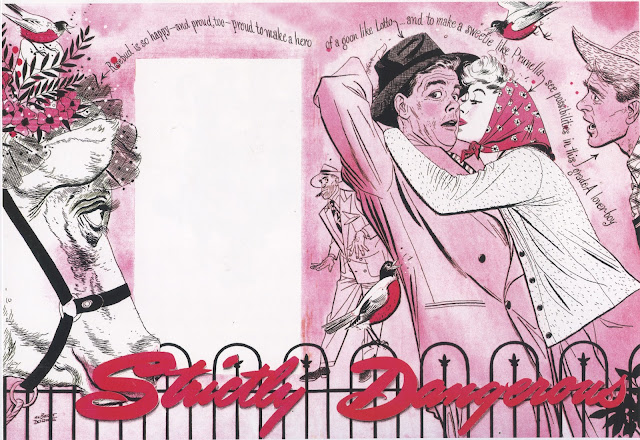
Illustrators were similarly prescient about the physical properties of light. The history books would have you believe that Einstein's Equivalence Principle first showed that light is not straight but bends around masses as a result of the curvature of space/time. But look at the aura of light that physicist Frank Frazetta discovered bending around these masses as a result of the curvature of space/time. Once again, the scientific community has conspired to deny an illustrator the credit he is due.


In fact, illustrators were also the first to discover that Newton's explanations for the properties of matter were inadequate to account for the behavior of flowing cloth on beautiful women. Only cloth engineered at the subatomic particle level using the latest nanotechnology could simultaneously flow so freely and yet cling so tightly:


Sadly, it is probably too late for illustrators to receive the credit they deserve for their important contributions to theoretical physics. The history books have been written and there are too many jealous scientists standing in the way.

But illustrators have identified other anomalies in the physical world that could affect other scientific disciplines. For example, note the following unusual behavior of plants that seems to contradict all known rules of classical botany:

Durer

Harold von Schmidt

Could we be far from a quantum theory of botany? And when that day comes, will illustrators finally get the credit they deserve?

Saturday, July 04, 2009

SKIN


Andrew Wyeth

There may be no better test of what's inside an artist than their response to what's on our surface.

The drama of human flesh has inspired a wide variety of artistic reactions. As John Updike noted, "the menace of and the sadness of naked flesh have impressed artists as much as its grandeur and allure."

In addition to inspiring such extraordinary reactions, skin provides artists with a broad and complex language for expressing feelings, thoughts and desires. Here are just a few small samples:

Toulouse Lautrec brilliantly captures the weight of flesh


In this detail from his watercolor of a weary stripper backstage, Burt Silverman distinguishes between the color of flesh that has been exposed to the sun and flesh that has never seen the light of day.


The ultra-cool Bob Peak lowers the temperature of skin to the level of liquid nitrogen


Gustav Klimt excelled at finding mythical eroticism in flesh


Andrew Wyeth puts flesh under his microscope and finds it radiant

Contrast these rich portrayals of our mortal envelope with the abject poverty of popular technicians such as Vargas or Olivia:


The disparity between these artistic treatments of the clues, promises and temptations of skin shows that for artists with searching eyes, skin can reveal inner life and personality that are the fuel for true eroticism, but for artists whose eyes stop at the surface, skin blocks any further inquiry and leaves them with a shallow and ultimately boring caricature of sexuality.

Artists such as Vargas and Olivia excel at painting firm flesh like sausage casing, but they seem oblivious to the cosmic significance of the freckles that they thoughtlessly airbrush from a bare shoulder.

I was reminded of the artistic importance of skin last week when artist
Kim Smith sent me an mpeg about the Omo river people in Africa who paint their skin in wondrously beautiful ways using natural pigments from the world around them.


If you can overlook its annoying quotes from Picasso, you may find this slide show about the Omo people as inspiring as I did:

Saturday, June 27, 2009

THE ILLUSTRATION ACADEMY

This week I played hooky for a few days to sit in on lectures at the Illustration Academy in Sarasota, Florida. The Academy assembles some of the most talented and successful illustrators in the country to discuss their work and teach young artists in hands-on sessions.

I had the pleasure of listening to presentations by
Mark English:


Sterling Hundley:


Gary Kelley:


Anita Kunz:


and
George Pratt:


If you tried to single out some distinguishing characteristic that accounted for the success of these illustrators, it was certainly not the way they marketed their services. (They had very different techniques.) Nor did they work in a common style-- they used a wide variety of approaches. It was not the stage of their careers (their ages range from 33 to 76) or the medium they used (some painted with computers and some painted with roofing tar). It was not their geographic location (they came from all around the US and Canada) or their gender or their politics. Yet, this group repeatedly won top awards and received choice assignments from the premiere publications.

So what did they all have in common?

It seemed to me that they all shared a deep curiosity about images and the interplay of form and content. Each of these illustrators had the enthusiasm and energy to cast their net again and again for fresh inspiration, exploring new themes and media. This, more than any career roadmap or promotional strategy, seemed to be their common ingredient. Not one of them lapsed into using a repetitive formula. I was surprised at how much of their work was self-generated; one persuaded a symphony orchestra to team with him in an experimental show of projected images to accompany Gustav Holst's
The Planets. Another went on a pilgrimage to the backwoods of the Mississippi delta to develop a project on the blues. Their broad intellectual curiosity added a richness to their illustrations that seemed to distinguish them from illustrators who took a more perfunctory approach.

Finally, I would like to add one other observation about my experience at the Illustration Academy. I've spent enough time around the New York art gallery scene to develop an extreme distaste for the phony hocus pocus that often accompanies the creation and sale of art. Sure, I respect the mystery of the muse-- my skin has tingled at the feel of her breath on the back of my neck-- but I can't stand it when her mystery is exploited to inflate a price or glamorize a particular artist. Many artists and art galleries today operate like the high priests in ancient times who cloaked sacred activity within a mystic tabernacle to keep the uninitiated awestruck.

The artists at the Academy, on the other hand, de-mystified everything they could legitimately de-mystify. They had a healthy respect for the role of the muse in creating art, but they did not expand her role for their own self-aggrandizement. Instead, they spoke in honest and functional terms about the genesis of ideas and the ways that art communicates. It was as clean a discussion of the making of art as I've heard in a long time, by people with a sincere interest in passing along helpful information to younger artists, and it reminded me why I like illustration so damn much.

Wednesday, June 17, 2009

SELLING OUT

Norman Rockwell recalled quite clearly the first time he sold out.

Humiliated by his family's poverty, Rockwell resolved to make money any way he could. It didn't take long for him to learn about "the depths of commercialism:"

Jack Arnold, my cousin, came home from Annapolis one holiday and offered me fifty cents to take my girl and him out in my boat. And I did it; I rowed facing the front of the boat while Jack and my girl hugged on the rear seat.
Rockwell quickly realized there were things he should not trade for money. Perhaps he was still smarting over his loss when he began sketching concepts for Saturday Evening Post covers a few years later:


Many people are quick to accuse commercial artists of selling out (unlike true artists who never compromise their art for money). Personally, I've never been very impressed by such claims. For one thing, charges of "selling out" are rarely leveled by people who have made meaningful contributions to the arts. Instead, it more often comes from gawkers and spectators with little understanding of survival in the market.

For another thing, "selling out" comes in all shapes and sizes but is rarely irreversible. I've never yet seen Mephistopheles assume the form of an art director and offer to buy a young artist's immortal soul. Illustrator Bob Heindel offered a far wiser and more practical view of how young artists start out making bad trade offs but can still redeem themselves:
We all got screwed around at the beginning. That’s how you learn. But you learn to protect yourself, and mostly, if you care about it you learn to protect your work. [An artist has to be] protective of his ability.... he [should] always want... the opportunities to do his very best.
Furthermore, even when an artist does succumb to crass commercial demands, the taint of commerce usually gets washed away by the passage of time. For example, nineteenth century symbolist painter Arnold Bocklin created a famous and haunting picture of the Isle of the Dead.


When a wealthy widow saw the painting in Bocklin's studio, she offered him good money to paint another version, but this time adding a woman and a coffin in the boat to represent the widow and her dear departed husband George. Bocklin responded with the German equivalent of "you betcha" and promptly painted the duplicate to satisfy her specifications. This version of Bocklin's painting is now on display in the Metropolitan Museum of Art in New York where nobody criticizes it as a "sell out."

Of course, some courageous artists never do compromise their art. For example, Monet refused to sell out. Rather than compromise his artistic principles to make his paintings more marketable, he lived off of others, begging money from his parents or anyone else he could persuade to give him a few francs. He was so principled that his family lived in abject poverty; his wife and children sometimes went without food so that Monet could be true to his art. Because he couldn't afford medical care, his wife Camille suffered through a long illness with tuberculosis before dying painfully at the age of 32. Some say she died of pelvic cancer, but others say she died of a botched abortion because she and Monet could not afford to raise a third child.

Don't think Monet's artistic dedication was compromised by Camille's tragic death; he told a friend that he was interested in the way Camille's face changed color after she died, so he recorded the change in a painting:


Now that's what I call principle.

Monday, June 15, 2009

ILLUSTRATING INFINITY

"The unutterable and the formless must needs be concealed"
.................--the Pythagorean brotherhood, circa 500 BCE


Saul Steinberg

Illustration art is commonly faulted for its "low" subject matter. Critics complain that, compared to fine art, Norman Rockwell's subjects were cheap and sentimental. Illustrations for the fiction in women's magazine or for shoe advertisements could never compare with "fine" art, where the artist has the freedom to address the most profound subjects.

But of course, there is no limit to the possible subject matter for an illustration.


Michelangelo's illustration of the Book of Genesis

In fact, the subject of an illustration can be more profound than the subject of so-called "fine" art, especially in an era like ours where fine art so often gravitates toward minor themes. Here is the art of contemporary art superstar Jenny Holzer:


Holzer takes platitudes fit for a fortune cookie and converts them into art by projecting them on the sides of buildings or flashing them on electric signs. It's hard to imagine Norman Rockwell settling for such simple minded content.

When it comes to profound, challenging subject matter, you can't aim any higher than the absolute. Great writers and artists sometimes aspire to "catch a glimpse of eternity through the window of time," transcending their small vantage point in history by identifying things immutable and great. Even if the quest for universal principles and eternal truths is a hopeless one, the mere search elevates the artist because it compels him or her to step outside of the fashions and styles of their day and focus on the most permanent things they are capable of conceptualizing. It stretches an artist to create forms commensurate with great themes.

Of course, great themes can also make an artist look foolish, which is one reason most artists don't try to go there any more. If you want to transcend the limitations of your time and place, it is disastrous to get too literal:


Here are some truly lovely examples of illustrations of the origin of the cosmos. These works, which were located and described by art historians Debra Diamond and Catherine Glynn, transcend some of the limitations of their time by reaching out to abstract beauty and putting aside literal solutions:


1. A color field of gold represents "the self-luminous Absolute."

2. The first manifestation of the cosmos

3. The siddha, "exuding silvery light (jyoti) engenders the next level of cosmic light and consciousness."

Now that's what I call sequential art! The difficulty of finding shapes and colors to portray such subjects is underscored by the corresponding text from the ancient Hindu treatise, Shiva Purana:
When the present world is not in existence, the Absolute alone is present. It is incomprehensible to the mind [and] cannot be expressed by words. It has neither name nor color.... it is immeasurable, propless, unchanging, formless, without attributes, perceptible to Yogins, all pervasive and the sole cause of the universe.
This next triptych conveys "The emergence of spirit and matter at the origin of the cosmos." I think spirit is the guy on the left:


One measure of the universal adaptability of this work is that it is compatible with modern scientific theory about the big bang, where the four fundamental forces (gravity, electromagnetism, strong interaction and weak interaction) emerged from nothingness at the origin of the universe.

An artist who attempts to realize timeless ideals by making an imperfect mark on a perishable surface reminds me of the Great Gatsby preparing to kiss Daisy:
He knew that when he kissed this girl, and forever wed his unutterable visions to her perishable breath, his mind would never romp again like the mind of God. So he waited, listening for a moment longer to the tuning-fork that had been struck upon a star.
And yet, you do it anyway. Without the commitment of that mortal kiss, what's the point of all that perfection?

.

Sunday, June 07, 2009

DRAWING WITHOUT ELECTRICITY

The painter Margaret Keane married a real jerk.

Early in her career, Keane created a popular style of painting children with huge, sad eyes. Although artistically dreadful, the paintings became wildly popular in the 1950s and 60s.


Keane's domineering husband Walter boasted that he painted the pictures, and he persuaded her to go along with his lie. For twelve long years, Walter took credit for Margaret's work. When their marriage dissolved and his meal ticket seemed about to disappear, Walter insisted that he owned the rights to the art, and even challenged Margaret's legal right to continue painting using the now famous "Keane" name. In court, it was his word against hers.

Then the judge came up with the ultimate test: he asked both Margaret and Walter to paint in front of the jury. Margaret successfully painted one of her trademark portraits. Walter claimed he was unable to paint due to a sore shoulder so they kicked his ass out of court.

There is no test of an artist more unambiguous than what he or she can do all alone with a pencil or brush. Again and again, people have returned to this standard as the measure of an artist.

After World War II, Han Van Meegeren was prosecuted for having sold an important cultural treasure, a Vermeer painting, to the Nazi occupiers . Faced with long imprisonment, Van Meegeren objected that he was not guilty because he personally forged the "Vermeer" he sold.


Scholars and art experts ridiculed his claim, but the court put him to the test by demanding that he paint another Vermeer in prison under observation. The testimony of Van Meegeren's brush was more persuasive than all of the art experts and scientists combined. The prosecutor dropped his charges of collaborating with Nazis (and prosecuted him instead for forgery).

Whether an artist is locked in a jail cell or isolated in a courtroom or stranded on a desert island, they always retain the crucial ingredients for their art: their eyes, fingers and mind. These are what the judges were trying to measure by eliminating interference from assistants, collaborators, photoshop, xerox machines, mechanical crutches or other such camouflage.

I sometimes think about the relevance of this test when I am enjoying the extraordinary new fruits of digital art. I have been dazzled by the brilliance of the animation art in Wall-E:


as well as the fabulous garden scene in Coraline.

These works of art are extraordinary and consuming, but they can neither be made nor viewed without the collaboration of utility companies to provide electrical power, financial institutions to provide funding, computer companies to develop software, and hundreds of animators, visual effects experts and other art professionals. None of them as an individual could "prove" their worth the way that Keane or Van Meegeren did for earlier generations. Today the creativity of electrical engineers can be as important as the creativity of the art director.

I sometimes wonder whether in the future this marvelous art form will eclipse more antiquated art forms, such as drawing and painting. And if it does, what will be the ultimate proof of an artist then?


Tuesday, June 02, 2009


Pieter Brueghel's masterpiece, The Tower of Babel, 1563


I do not call one greater and one smaller,
That which fills its period and place is equal to any.
..................................-- Walt Whitman


John Singer Sargent's preliminary design for his portrait of the Wyndham sisters

..